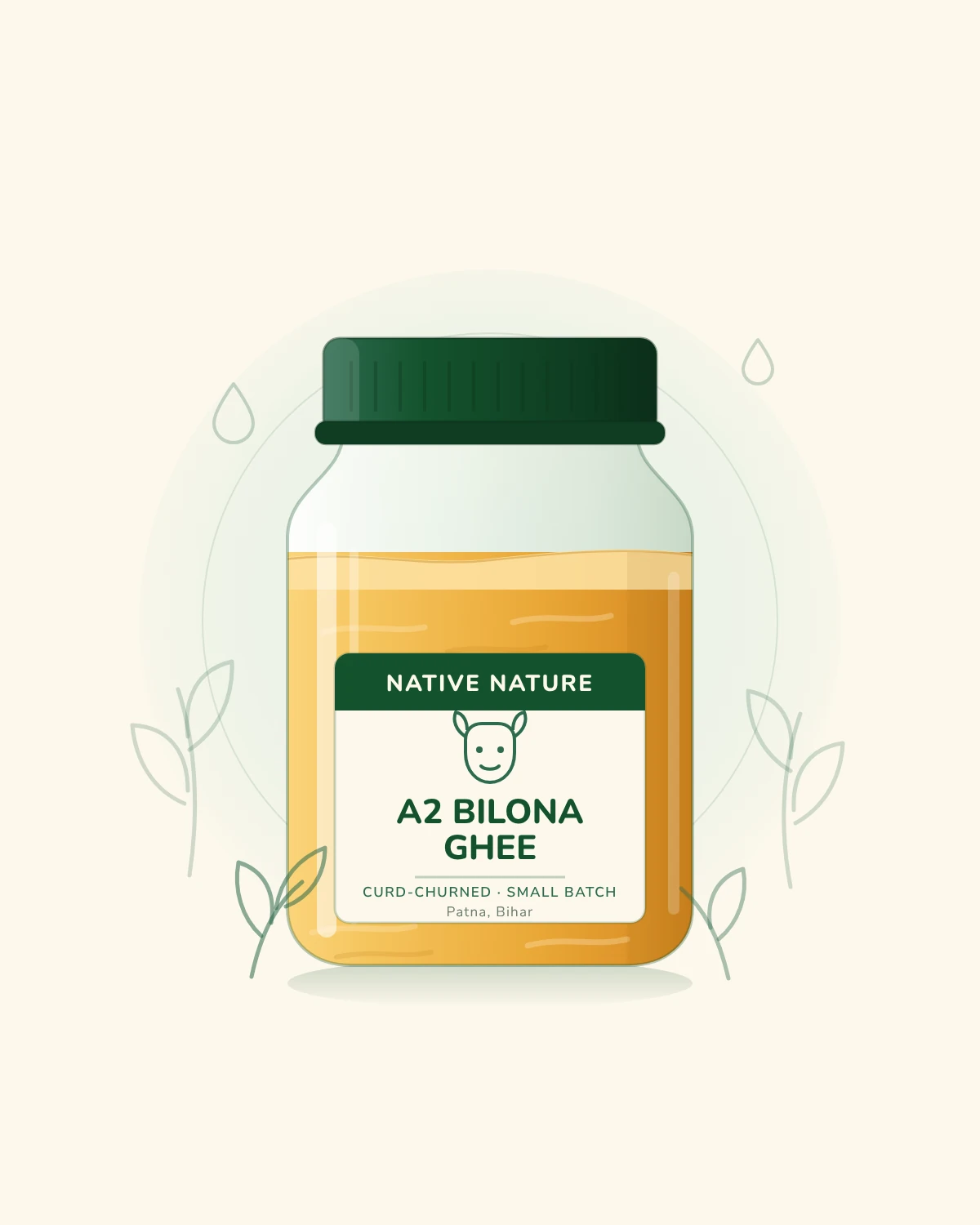
A2 Gir Cow Bilona Ghee
Price range: ₹2,000 through ₹8,000
Hand-churned bilona ghee made from A2 Gir cow milk. Prepared the traditional way from cultured curd, in small batches, with nothing added.
Storage. Keep in a cool, dry place away from sunlight and use a clean, dry spoon. Ghee may turn grainy or solid with the weather — that is normal and does not affect quality.
- Direct from our farmNo middlemen
- Delivered in PatnaTo your doorstep
- Gir cows onlyOur own herd
Some things cannot be hurried
Most ghee sold today is made from cream, separated by machine and clarified in bulk. Bilona ghee takes the long way round — milk is set into curd first, the curd is churned until butter lifts out of it, and only then is that butter cooked down into ghee.
It is slower, it takes more milk, and it is the way ghee was made in Indian kitchens before any of it was made in factories. We make ours from the milk of the same Gir cows we deliver each morning.
-
01 — CURD FIRST
Not cream
Bilona begins with dahi. The milk is cultured and set before anything is taken out of it — that single choice is what separates this from ordinary ghee.
-
02 — CHURNED
Butter, lifted out
The set curd is churned until the makhan rises and separates. This is the step that gives bilona ghee its aroma and its grain.
-
03 — SLOW HEAT
Small batches
The butter is cooked down gently, never rushed. Push the heat to save time and you lose the colour, the smell and the taste.
Four stages, one day’s milk
Every jar starts as milk from our own herd and passes through all four. There is no shortcut that produces the same thing at the end.
-
1
Fresh Gir milk
From the same cows, the same morning — the milk we would otherwise deliver.
-
2
Set into curd
Cultured and left to set overnight, the way dahi is set at home.
-
3
Churned to makhan
The curd is churned until fresh white butter separates and rises.
-
4
Cooked into ghee
Slowly heated, filtered and cooled until it sets golden and grainy.
Know your ghee
| Brand | Native Nature |
| Sold by | Pitvas Naturals Private Limited |
| Made from | Milk of our own Gir cows |
| Method | Bilona — curd, churned to butter, slow-cooked |
| Batch | Small batches, made to order |
| Sizes | 500 g to 2 kg |
| Farm | Fatehpur, Patna, Bihar |
| Delivery | Across Patna |
| Storage | Cool, dry place. Clean dry spoon. No refrigeration needed. |
A spoon changes the dish
- Dal tadka and khichdi
- Roti, paratha and puri
- Halwa, laddoo and festive sweets
- Rice, pulao and everyday cooking
- A spoonful over hot dal, straight from the jar
Ghee is concentrated milk fat, so a little does the work of a lot. Enjoy it in measured amounts as part of a balanced diet.
Before you order
What does “bilona” actually mean?
It is the churn itself — the wooden implement used to beat set curd until the butter separates. The name has come to mean the whole method: milk to curd, curd to butter, butter to ghee. If ghee was made from cream instead, it is not bilona, whatever the label says.
How is it different from the ghee in shops?
Mostly in where it starts. Commercial ghee is usually made by separating cream from milk by machine and clarifying that. Ours goes through curd and churning first, which takes an extra day and more milk. The difference you will notice is in the aroma and the grain — it is a difference of method and taste, not a medical one.
Does ghee contain A2 protein?
Almost none, and we would rather say so. Ghee is milk fat — the milk solids are removed during cooking, and with them nearly all the protein. “A2” here describes the milk it came from, not what is left in the jar. If you want A2 protein, drink the milk.
Why has my ghee gone grainy or solid?
That is normal, and usually a good sign. Ghee sets, softens and turns grainy depending on the weather and how it cooled. It does not mean anything has gone wrong, and it does not need refrigerating. Keep it covered, use a dry spoon, and keep water out of the jar.
Why is it this expensive?
Because a jar of ghee is a great deal of milk. It takes many litres to make a single kilogram, and the bilona route adds a full day of setting and churning on top of that. We would rather charge what it costs to make properly than cut the method to reach a lower price.